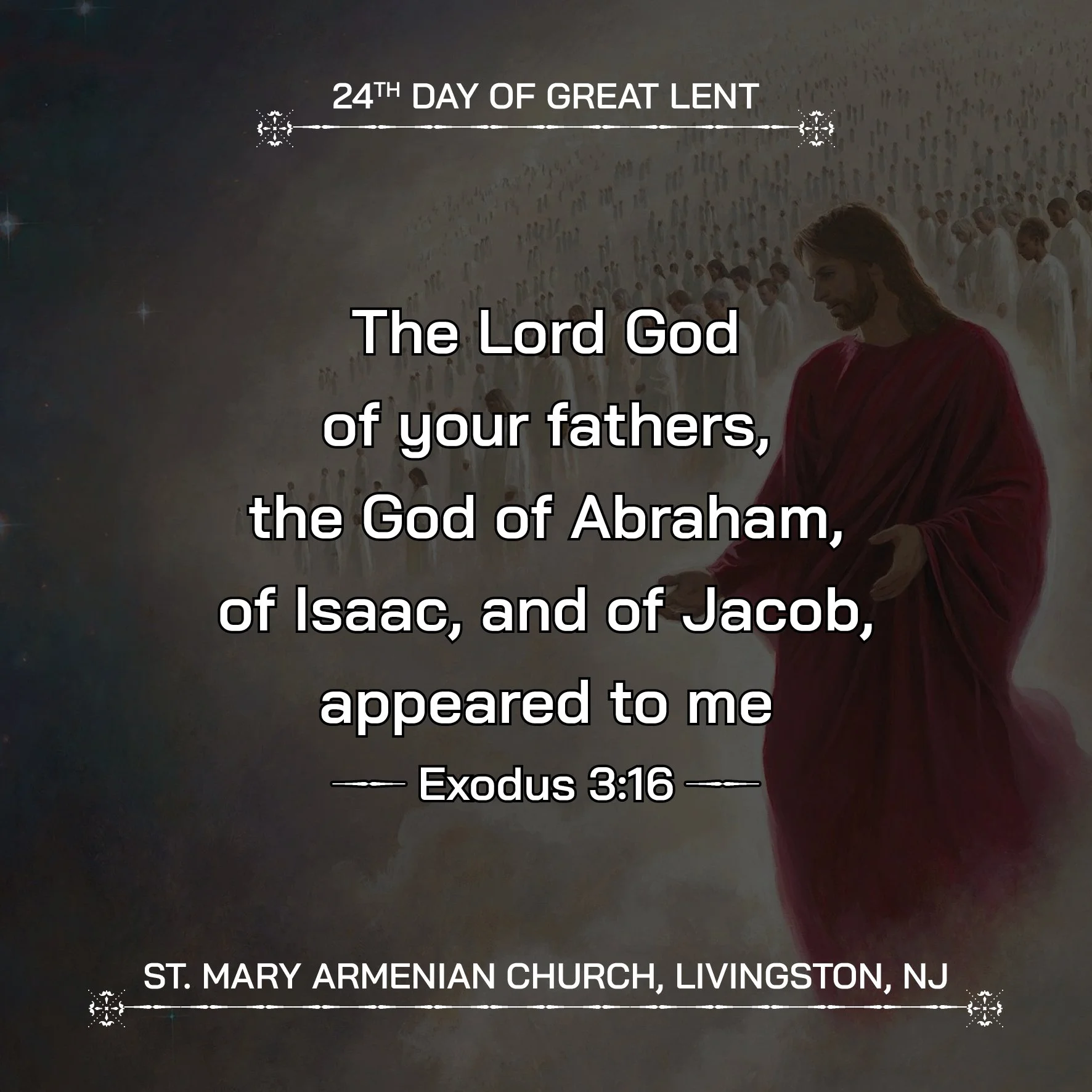
MIDDAY OF THE GREAT LENT
ՄԻՋԻՆՔ | MEECHEENK
In the spiritual rhythm of the Armenian Church, Meecheenk (Միջինք) marks the midpoint of Great Lent. Its name simply means “middle,” yet its meaning is profound: we stand halfway along the road of repentance, self-examination, and renewal.
Meecheenk does not interrupt the Lenten fast. The discipline continues unchanged. Instead, the day serves as a gentle reminder that twenty-four days remain until the radiant joy of Holy Easter—the Resurrection of our Lord Jesus Christ. Before the triumph of Pascha comes continued reflection, repentance, reconciliation, and charity.
A Pause for Reflection
Great Lent is a sacred journey of self-purification. Meecheenk calls us to pause and ask: How have we walked this path so far? Have we forgiven those who wronged us? Have we examined our hearts? Have we practiced mercy and generosity?
Before the joy of the Resurrection, the Church invites us to deepen our inner work—confession, prayer, fasting, and good deeds. The midpoint is not a celebration, but an encouragement: continue faithfully; the light of Easter is drawing nearer.
Liturgically, Meecheenk is simple. The services are not especially elaborate. However, beginning on this day, during the Peace Hour service, solemn hymn verses known as “Steghi” are sung in a heavy and majestic tone, reminding the faithful of the serious yet hopeful character of the season.
Folk Traditions of Meecheenk
Alongside its spiritual meaning, Meecheenk is rich in Armenian folk custom.
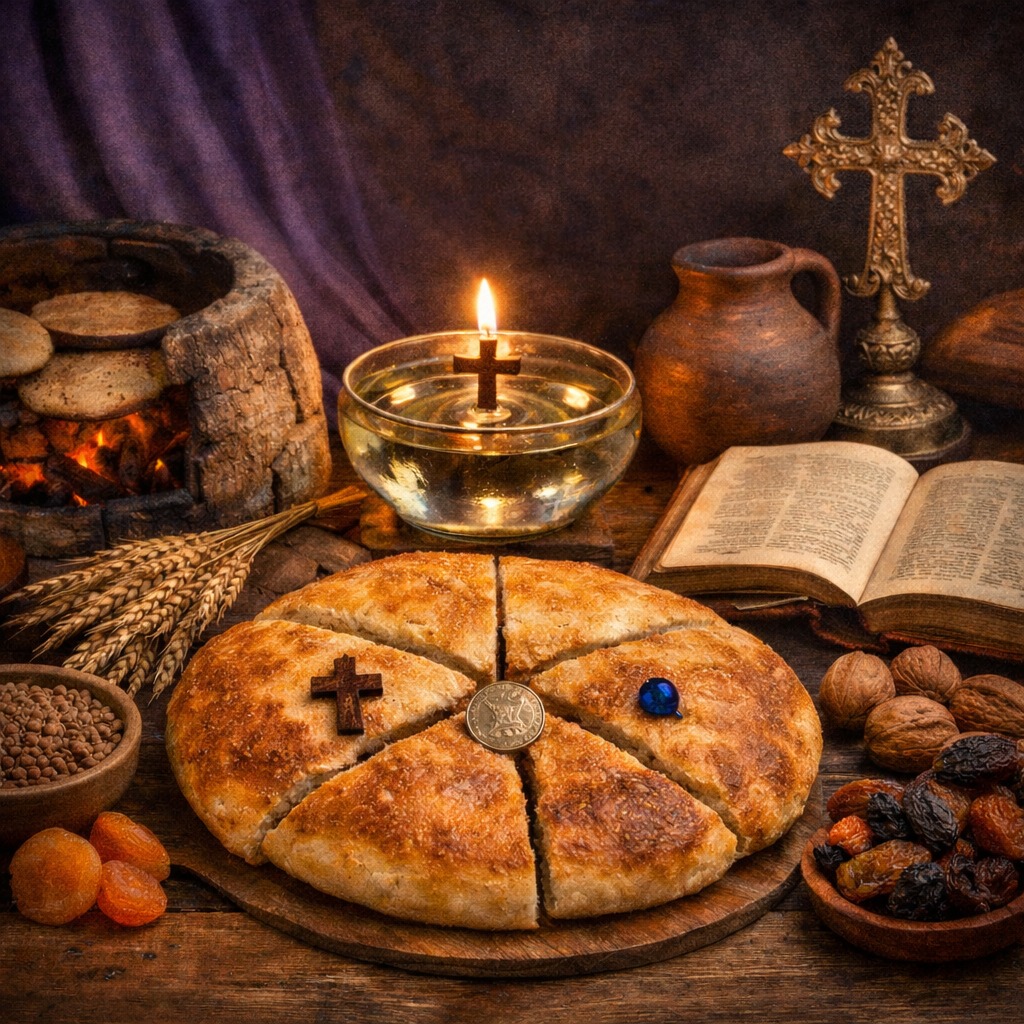
Traditionally, Armenian housewives prepare a special Lenten flatbread—often called gahda or bagharj. Inside the bread, they hide symbolic items: a coin, a bead, a small paper with a Psalm written on it, or a small wooden cross. The bread is divided among all members of the household; portions are also set aside for livestock and even for the land.
Whoever receives the coin, bead, or cross is believed to be blessed with good fortune throughout the year. If the knife cuts directly through the hidden coin, the blessing is said to belong to the entire family.
In some regions of Armenia, on the eve of Meecheenk, churches prepare a ritual mixture of water and oil in a bowl, where a cross-shaped wick burns overnight. This is called “leechk.” In the morning, the blessed water is distributed to the faithful, who mix it into the dough when baking the Meecheenk bread.
Many Names, One Meaning
Across Armenia and historic Armenian regions, the Meecheenk bread is known by many names: midunk, midnabaghj, kloch, palits, choruk, haregil, midnak loch, midnaplit, majinq, kutap, and others. Though the names vary, the symbolism remains the same: the fast has reached its halfway point.
In several areas, especially in Syunik and Vayots Dzor, people prepared kutap—a pastry made by flattening dough balls, filling them with boiled beans, chickpeas, broad beans, onions, or other vegetables, folding them into round or oval shapes, and baking them in the tonir (traditional clay oven).
When the kutap was ready, young brides and girls would take their portions and go together to a green field or gathering place. On this day, they were free from the supervision of elder women. They shared their joys and sorrows, spoke about married life, formed circle dances, and finally ate their kutap together. Meecheenk thus became not only a spiritual pause, but also a moment of sisterhood and mutual support.
Sensitivity and Solidarity
Families who had recently experienced a death did not prepare Meecheenk bread. In Mush and Taron, however, female relatives would bake special haregil bread and bring it to mourning families on the evening of Meecheenk—a gesture of comfort and solidarity.
In New Nakhichevan, people would symbolically cut only half of a feather representing the weeks of Lent, to show that the fast had been divided in half. Among the people of Musa Dagh, the day was known as “Aghtsuts Gis” (“Half of Salt and Bread”), emphasizing the simplicity and sacrificial nature of the Lenten table.
In Sisian, the family of an engaged young man would send a special gift tray (khoncha) to the bride’s house on Meecheenk. It included oil-based pastries, a jug of wine, and a bottle of vodka. In some regions, the custom of bringing spirits was so widespread that in Dersim, the first Monday of Lent was called “Oght Rakhii Or” (“The Day of Seven Vodkas”).
The Heart of Meecheenk
Beyond all customs and regional variations, the heart of Meecheenk remains spiritual. It stands as a signpost on the road to the Resurrection. It reminds us that Lent is not merely about abstaining from food, but about inner transformation.
We are halfway through the journey of self-purification. The Cross still stands before us; the empty Tomb awaits. Meecheenk gently urges us: continue the struggle, deepen your repentance, reconcile with one another, and prepare your soul—so that when Easter dawns, your heart too may rise in new life.
SCRIPTURE READINGS
~ Exodus 3:16-22 ~
Go and gather the elders of Israel together, and say to them, 'The Lord God of your fathers, the God of Abraham, of Isaac, and of Jacob, appeared to me, saying, "I have surely visited you and seen what is done to you in Egypt; and I have said I will bring you up out of the affliction of Egypt to the land of the Canaanites and the Hittites and the Amorites and the Perizzites and the Hivites and the Jebusites, to a land flowing with milk and honey." ' Then they will heed your voice; and you shall come, you and the elders of Israel, to the king of Egypt; and you shall say to him, 'The Lord God of the Hebrews has met with us; and now, please, let us go three days' journey into the wilderness, that we may sacrifice to the Lord our God.' But I am sure that the king of Egypt will not let you go, no, not even by a mighty hand. So I will stretch out My hand and strike Egypt with all My wonders which I will do in its midst; and after that he will let you go. And I will give this people favor in the sight of the Egyptians; and it shall be, when you go, that you shall not go empty-handed. But every woman shall ask of her neighbor, namely, of her who dwells near her house, articles of silver, articles of gold, and clothing; and you shall put them on your sons and on your daughters. So you shall plunder the Egyptians."
~ Joel 3:1-8 ~
"For behold, in those days and at that time, When I bring back the captives of Judah and Jerusalem, I will also gather all nations, And bring them down to the Valley of Jehoshaphat; And I will enter into judgment with them there On account of My people, My heritage Israel, Whom they have scattered among the nations; They have also divided up My land. They have cast lots for My people, Have given a boy as payment for a harlot, And sold a girl for wine, that they may drink. "Indeed, what have you to do with Me, O Tyre and Sidon, and all the coasts of Philistia? Will you retaliate against Me? But if you retaliate against Me, Swiftly and speedily I will return your retaliation upon your own head; Because you have taken My silver and My gold, And have carried into your temples My prized possessions. Also the people of Judah and the people of Jerusalem You have sold to the Greeks, That you may remove them far from their borders. "Behold, I will raise them Out of the place to which you have sold them, And will return your retaliation upon your own head. I will sell your sons and your daughters Into the hand of the people of Judah, And they will sell them to the Sabeans, To a people far off; For the Lord has spoken."