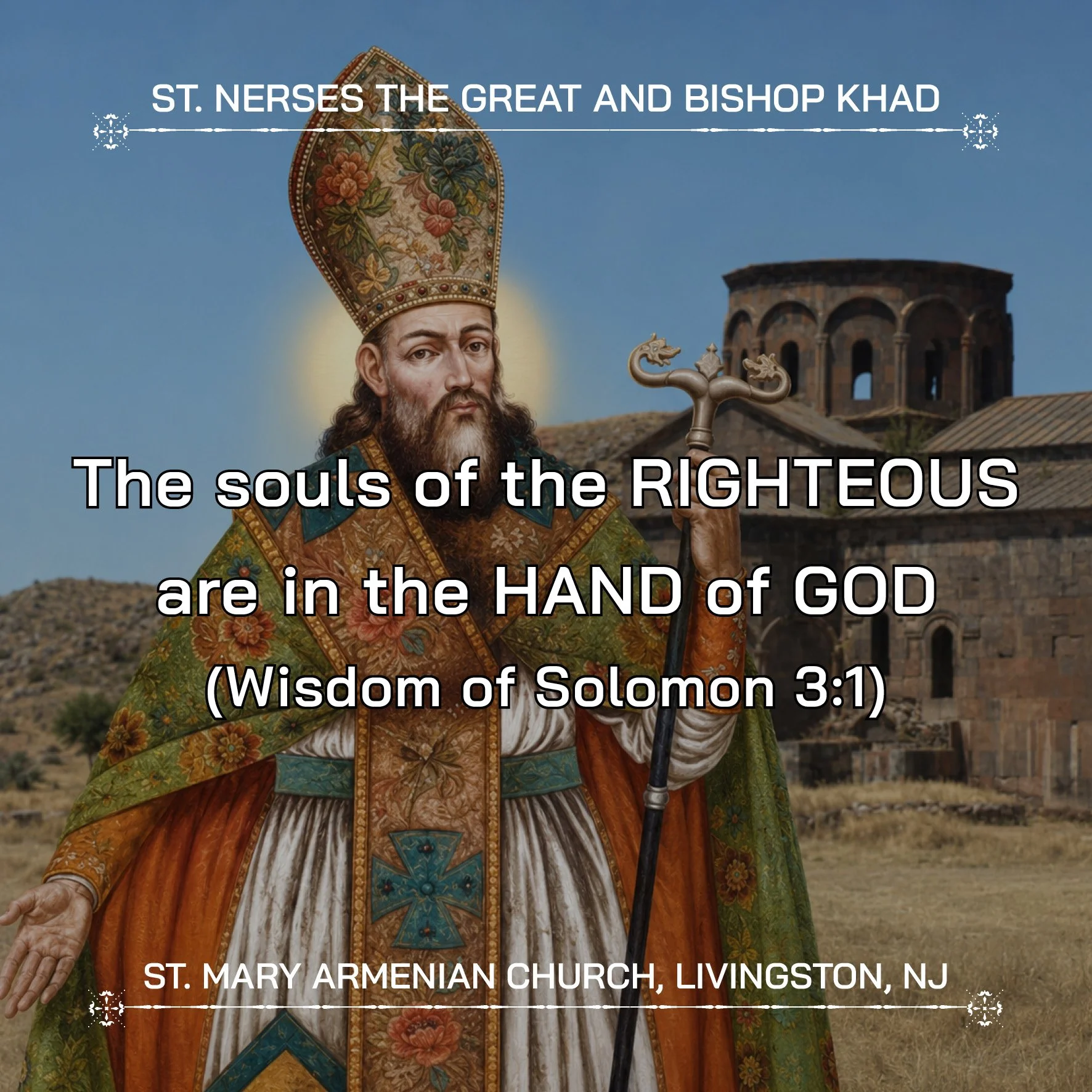
Commemoration Day of
St. Nerses the Great,
Catholicos of All Armenia,
and Bishop Khad
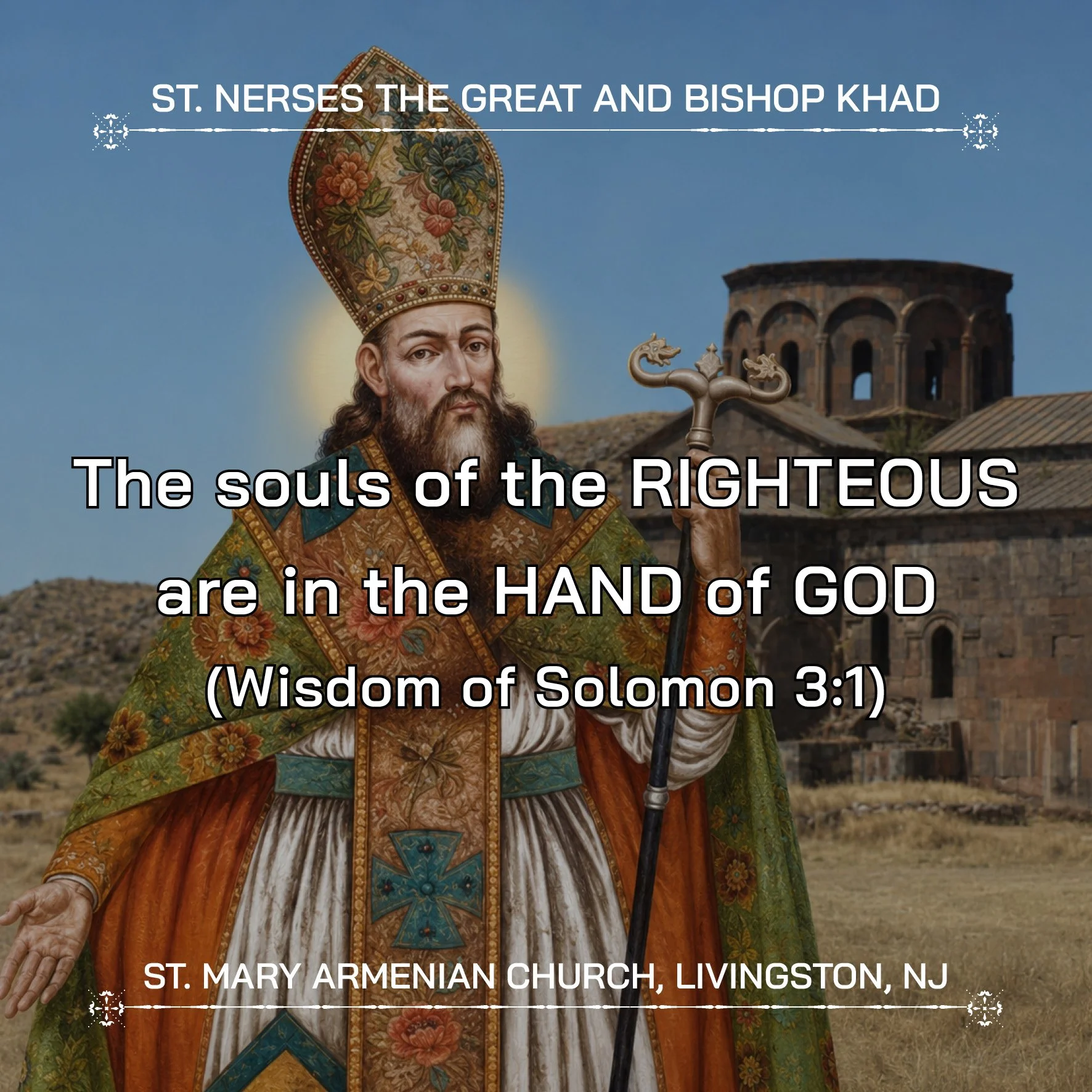
St. Nerses the Great, Catholicos of ALL Armenia
Saint Nerses the Great was the grandson of Catholicos Husik and the son of Athanagines, one of Husik's twin sons. These twin brothers never desired to enter the clerical life and instead devoted themselves to a worldly and dissolute existence. According to tradition, both eventually died after being struck by lightning.
Nerses was the only descendant of Saint Gregory the Illuminator who was born in Armenia itself; all the other members of the family line had been born in Caesarea. He received his education in Caesarea, however, and from an early age married a noblewoman named Sandukht of the Mamikonian family. They had one son, who would later become Saint Sahak (Isaac) the Catholicos.
Not long after the birth of their son, Sandukht died in Caesarea. Nerses and his father brought her body to Armenia and buried her in the district of Til, an estate belonging to the family of Saint Gregory, where Catholicos Aristakes had also been laid to rest.
Nerses continued his studies in Caesarea, where he was a contemporary of the great Cappadocian Fathers—Gregory Nazianzen, Basil of Caesarea, and Gregory of Nyssa—who were born around the same years as he was. Upon completing his education, he returned to Armenia and was invited to the royal court by his maternal uncle, King Arshak II, where he rose to a prominent position.
After the death of Catholicos Pharen, who was not a member of the family of Saint Gregory, the Armenian Church sought a new Catholicos. The people strongly desired someone from the Illuminator's lineage, and all eyes turned toward Nerses. Despite his reluctance, and largely through the influence of King Arshak, Nerses was elected Catholicos of Armenia in 353 A.D., when he was only twenty-five years old.
Character and Appearance
The historian Pavstos Buzand gives a striking description of Nerses: "Nerses was a man of imposing stature, tall, broad-shouldered, and handsome, such that no equal could be found in the land. As a military man, his bravery was the envy of all."
His moral character was described in even higher terms: "He possessed the fear of God, kept His commandments, was compassionate, holy, prudent, wise, and impartial. By nature he was peace-loving, humble, gentle, and a lover of the poor. Perfect in the love of God, he loved his neighbor as himself according to the Lord's commandment... From childhood he kept God's commandments. He was righteous, pure, and devoted to service. Zealous for God's glory and tireless in prayer. Filled with the Holy Spirit—in every respect he was perfect."
At the assembly convened to elect the new Catholicos, Nerses stood beside the king in full military splendor, wearing noble garments, a jeweled belt, and carrying a richly ornamented sword. The assembled bishops and nobles cried out: "Let Nerses be our shepherd!"
Nerses resisted, declaring himself unworthy: "You do not keep God's laws and are immersed in sinful deeds. I cannot be your shepherd, for I cannot show partiality, overlook your sins, or tolerate your wickedness. Today you show me affection, but tomorrow you will hate me. Let me live my own life with God's judgment always before my eyes."
King Arshak nevertheless compelled him to accept. His sword was removed, his royal attire exchanged for clerical vestments, his hair cut, and he was immediately ordained a deacon. Soon afterward he was sent with great honor to Caesarea to be consecrated bishop and Catholicos of Armenia.
His Reforming Ministry
Upon returning from Caesarea, Nerses immediately dedicated himself to preaching and pastoral care.
According to Pavstos: "He began the supervision of the flock, providing spiritual nourishment to all and delivering beneficial teachings without fault."
He strengthened the wavering, comforted believers, silenced slanderers, encouraged seekers of justice, and nourished the Armenian people with his teachings.
Nerses soon undertook an ambitious program of social and ecclesiastical reform. He convened a great council at Ashtishat, one of Armenia's principal religious centers, where he outlined plans for widespread charitable institutions:
Poorhouses for the needy.
Hospitals for the sick.
Shelters for lepers and those suffering from contagious diseases.
Hostels for travelers.
Endowments of villages and estates to sustain these institutions.
He also sought to organize church life more effectively by:
Establishing monasteries for celibate clergy.
Creating hermit communities for ascetics.
Establishing episcopal residences and administrative centers.
The council enacted numerous reforms, including:
Prohibiting marriages between close relatives.
Establishing strict penalties against adultery, immorality, and sexual misconduct.
Condemning theft, robbery, and exploitation.
Forbidding pagan mourning rituals and funeral customs.
Requiring nobles to treat their dependents with justice and compassion and to avoid excessive taxation.
His reforms extended beyond the Church into every aspect of Armenian social life. For this reason, historians regard him as one of Armenia's greatest social reformers.
Education and Learning
Nerses also promoted education. Since the Armenian alphabet had not yet been invented, he established schools where Greek and Syriac were taught.
Students studied the Scriptures and simultaneously translated them orally into Armenian during public readings. These schools gave rise to the offices of interpreters and translators within the Church.
Among the students educated through this system were:
His son, Saint Sahak the Catholicos.
His trusted disciple, Mesrop Mashtots.
These two men would later create the Armenian alphabet and become the founders of Armenian literature.
Conflict with Kings
At first, Nerses enjoyed a positive relationship with King Arshak II. Over time, however, Arshak abandoned his earlier virtues and became increasingly unjust and immoral. Nerses repeatedly admonished him but was ignored.
Eventually Nerses withdrew from court affairs and devoted himself entirely to religious work.
Meanwhile, Persian invasions intensified. Although the Armenian army under Vasak Mamikonian initially resisted successfully, King Arshak was eventually deceived by the Persian king Shapur II, imprisoned, and died in captivity.
His son King Pap succeeded him. At first Pap followed Nerses' guidance. Their cooperation contributed greatly to Armenia's celebrated victory over Persia at the Battle of Dzirav, where Nerses stood on nearby Mount Npat with outstretched arms praying for the Armenian army.
After peace was restored, however, Pap gave himself over to luxury and immorality. Nerses repeatedly rebuked him and eventually forbade him from entering the church.
Pap consequently became Nerses' enemy and is traditionally accused of poisoning him.
Patriarch Malachia Ormanian, however, questioned this account. He suggested that Nerses was already suffering from a serious heart and lung disease, exacerbated by years of exhausting labor and grief over Pap's conduct. According to this interpretation, his death may have been due to natural causes rather than poisoning.
Saint Nerses died in 373 A.D., only forty-five years old.
He was buried in Til, beside his wife Sandukht and near Catholicos Aristakes. Because both patriarchs rested there, the monastery eventually became known as "The Monastery of the Two Patriarchs."
Although the church at Til was destroyed in the seventh century, the saint's tomb was rediscovered in 1275. Portions of his relics were later transferred to churches in Erzincan and the surrounding region.
Legacy
Nerses' accomplishments earned him the title "the Great."
His greatest contribution was the moral, ecclesiastical, and social reform of Armenian life. While earlier patriarchs had focused primarily on preaching and spreading the faith, Nerses combined spiritual renewal with practical social action, transforming the daily lives of the people.
For this reason, Armenian tradition honored him as: "The Illuminator of Hearts."
The Armenian Church commemorates Saint Nerses the Great together with Bishop Khad on the Saturday following the Feast of the Holy Cathedral (Catholike Church).
In Western reference works, including Catholic and Oxford dictionaries of saints, his feast day is often listed as November 19.
A hymn dedicated to him in the Armenian Sharakan tradition proclaims:
Today the pastoral staff is renewed once more,
For a mighty shepherd has been granted to the rational flock.
From the root of the Illuminator sprang forth Saint Nerses like a fresh shoot.
Through his intercession, O Lord, strengthen the authority of the Patriarchal Throne.
Bishop Khad
Bishop Khad was the closest associate and lifelong collaborator of Saint Nerses the Great, much as the Syrian Daniel had been a companion of Saint Gregory the Illuminator.
He was from the village of Maraga in the district of Karin and had been raised and educated under Nerses' guidance from childhood. He was intelligent, faithful, and exceptionally devoted both to the Armenian Church and to the poor.
Because of these qualities, Nerses entrusted him with oversight of the Church's charitable institutions.
When Nerses was forced to leave Armenia, he consecrated Khad as bishop over the province of Bagrevand and the district of Arsharunik, appointing him as his deputy. As the historian records: "He left him as his representative in his place."
During Nerses' absence, Khad instructed the entire nation to observe fasting and prayer for the speedy return of their shepherd. Throughout this period he governed the Armenian Church without falling short of Nerses in zeal or dedication.
Defender of Justice
Like Nerses, Khad fearlessly rebuked wrongdoing.
When King Arshak and many nobles abandoned God's commandments and embraced corruption, Khad openly reproved them. The king attempted to win him over with gifts, but Khad distributed all the gifts to the poor in the king's presence and continued his denunciations.
Eventually Arshak ordered him expelled from the royal court.
Afterward, Khad traveled throughout Armenia preaching, teaching, reforming society, and caring for the poor.
His biographer records: "Through his hands many signs, miracles, powers, and healings were performed among the sick."
According to Pavstos, whenever Khad distributed all available food and supplies to the poor, the storehouses would miraculously be found replenished the next day by God's providence.
The historian concludes: "Among the Armenians this man was wonderfully renowned and marvelous."
The Story of the Stolen Oxen
One famous episode from Khad's life remarkably anticipates the famous act of mercy later described in Victor Hugo's Les Misérables.
One day thieves stole the oxen belonging to Khad's church. Immediately afterward they were struck blind. Not understanding what had happened, they drove the oxen back to the church property.
Khad prayed for them, and their sight was restored.
Rather than punishing them, he ordered that they be bathed, prepared a rich feast for them, comforted them, and then sent them away in peace, giving them both his blessing and the oxen themselves.
This extraordinary act of mercy led to the thieves' repentance and conversion.
Final Years and Legacy
Khad was married and had two daughters. One daughter married a man named Astik, who later succeeded him as bishop of Arsharunik.
The historian Movses Khorenatsi wrote of him: "In every way he resembled the great Nerses."
Pavstos Buzand even called him Nerses' "partner on the episcopal throne."
One weakness often mentioned was that he loved fine clothing and fine horses. Those whom he rebuked frequently mocked him for this. In response, Khad renounced his luxurious garments, clothed himself in coarse attire, and thereafter traveled only on a donkey.
At one point, after he sharply condemned King Arshak for acts of violence and murder, the king ordered him dragged away and stoned. Members of the powerful Apahuni family intervened, rescued him from his attackers, and saved his life.
The exact date of Khad's death is unknown, though he is generally believed to have died before Saint Nerses.
Patriarch Ormanian summarized his significance: "The breadth of responsibility entrusted to Khad and the confidence Nerses placed in him constitute his greatest praise. Both in charitable labor and administrative genius, history presents him as a second Nerses."
Just as Khad was inseparable from Nerses in life and ministry, he remains inseparable from him in the Church calendar.
The Armenian Church commemorates Saint Nerses the Great and Bishop Khad together on the Saturday following the Feast of the Holy Cathedral (Catholike Church).
SCRIPTURE READINGS
~ Wisdom of Solomon 2:23-3:8 ~
For God created us for incorruption, and made us in the image of his own eternity, but through the devil's envy death entered the world, and those who belong to his company experience it.
But the souls of the righteous are in the hand of God, and no torment will ever touch them. In the eyes of the foolish they seemed to have died, and their departure was thought to be a disaster, and their going from us to be their destruction; but they are at peace. For though in the sight of others they were punished, their hope is full of immortality. Having been disciplined a little, they will receive great good, because God tested them and found them worthy of himself; like gold in the furnace he tried them, and like a sacrificial burnt offering he accepted them. In the time of their visitation they will shine forth, and will run like sparks through the stubble. They will govern nations and rule over peoples, and the Lord will reign over them forever.
~ Isaiah 57:15-16 ~
For thus says the high and lofty one who inhabits eternity, whose name is Holy: I dwell in the high and holy place, and also with those who are contrite and humble in spirit, to revive the spirit of the humble, and to revive the heart of the contrite. For I will not continually accuse, nor will I always be angry; for then the spirits would grow faint before me, even the souls that I have made.
~ Hebrews 13:7-9 ~
Remember your leaders, those who spoke the word of God to you; consider the outcome of their way of life, and imitate their faith. Jesus Christ is the same yesterday and today and forever. Do not be carried away by all kinds of strange teachings; for it is well for the heart to be strengthened by grace, not by regulations about food, which have not benefited those who observe them.
~ Holy Gospel of St. Matthew 10:16-22 ~
"See, I am sending you out like sheep into the midst of wolves; so be wise as serpents and innocent as doves. Beware of them, for they will hand you over to councils and flog you in their synagogues; and you will be dragged before governors and kings because of me, as a testimony to them and the Gentiles. When they hand you over, do not worry about how you are to speak or what you are to say; for what you are to say will be given to you at that time; for it is not you who speak, but the Spirit of your Father speaking through you. Brother will betray brother to death, and a father his child, and children will rise against parents and have them put to death; and you will be hated by all because of my name. But the one who endures to the end will be saved.